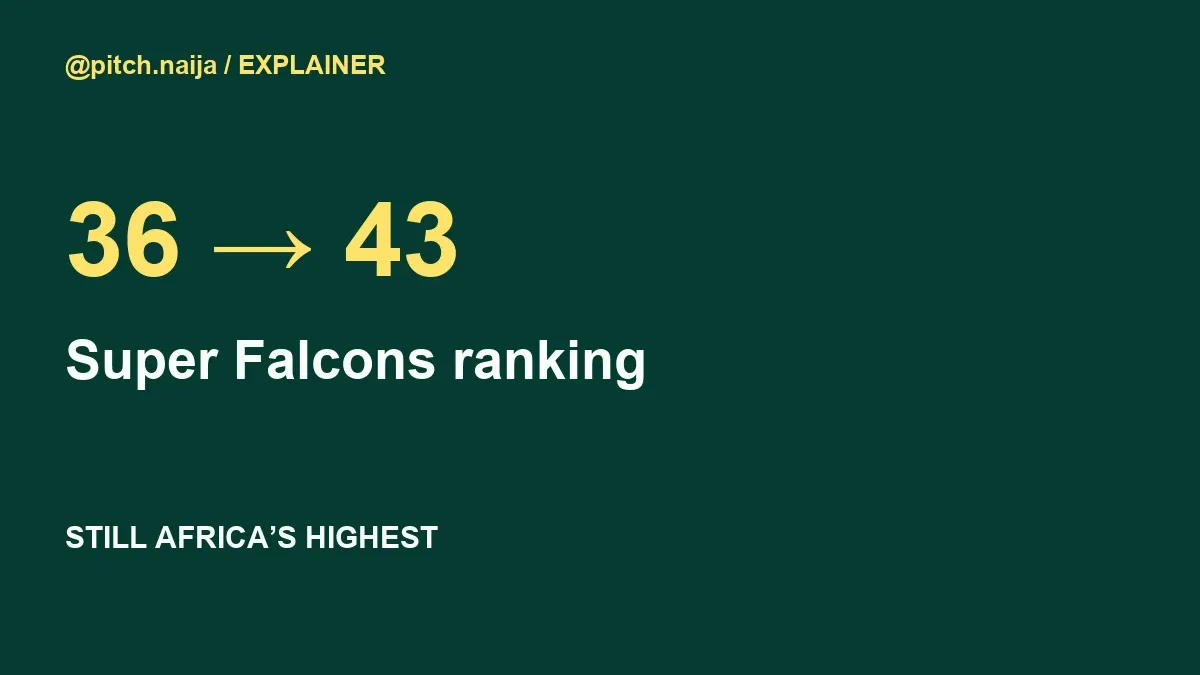
Nigeria’s Super Falcons have fallen from 36th to 43rd in the October FIFA women’s ranking while remaining Africa’s highest-ranked team. For Nigerian supporters, those two facts can sit together: a team can retain its continental position and still lose ground against the wider international field.
ACLSports and PM News both report the seven-place drop in the update released on 20 October. ACLSports gives Nigeria’s new total as 1,518.02 points, down 83.54. Those figures describe a ranking snapshot, not a scoreline, and should not be confused with the number of places a team might gain by winning its next match.
FIFA’s release says the latest ranking followed 183 matches across recent international windows. It identifies the 2026 Women’s Africa Cup of Nations as having ‘the biggest influence on this update’. That is FIFA’s assessment of the overall release, rather than a claim that one isolated Nigeria fixture explains every point lost.
The contrast is useful for judging progress. Being first in Africa is a relative position among continental rivals; moving down globally measures a different comparison. Neither statement, by itself, tells a coach which pass broke down, whether a pressing scheme worked or how well the team created chances. Match evidence is still needed to answer those football questions.
For fans, the sensible response is to track results and performances alongside the published ranking rather than treating either as the only verdict. Improvements in preparation, player availability and execution matter on the pitch before they can be reflected in a future table. FIFA says the next edition will be released on 7 December, giving supporters a clear checkpoint without promising an automatic recovery. Which should carry more weight in judging the Falcons’ next phase: their results, the quality of their performances or their ranking movement?